
Self-service web app
This project focused on building a self care app from scratch with features like my services, billing, usage, payments and profile and settings.
Client
Hansen technologies
Role
UX Designer
Duration
9 Months
Year
2022
Overview
The Self-Care Web & App is a holistic utility management platform designed to help users manage essential services such as electricity, water, gas, and waste, while also encouraging sustainable behavior and personal well-being. The product combined traditional utility self-service with self-care and sustainability features, enabling users to independently manage tasks, track consumption, and manage their payments and subscriptions.
Users needed a single central platform to manage multiple utility services, but existing solutions were fragmented, transactional, and focused only on bill management. Additionally, there was little support for encouraging sustainable behavior or empowering users to take long-term control of their usage. The challenge was to balance functionality rich and simplicity while promoting positive behavior and protecting user privacy.
Solution
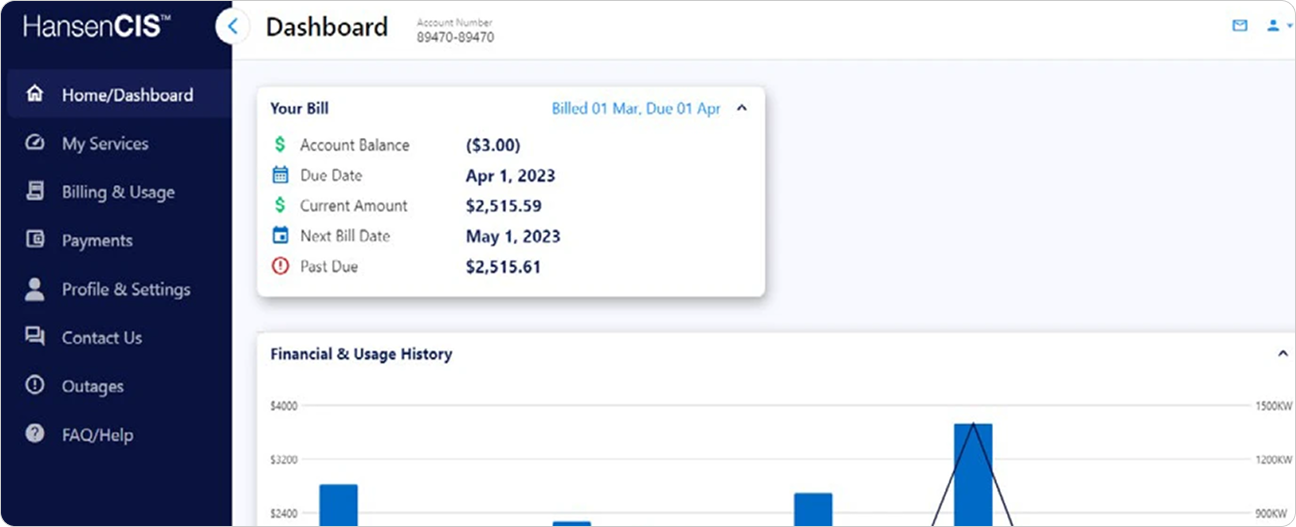
The solution not only facilitated the management of utility services but also focused on user well-being with a intuitive user interface where they could manage their services by themselves without having to call a CSR all times. The UX strategy focused on empowering users through self-service, while seamlessly integrating sustainability and self-care into everyday utility management.
- 1. Centralize utility management into a single, unified experience
- 2. Reduce complexity by simplifying high-frequency tasks and workflows
- 3. Encourage sustainable behavior through insights, reminders and goal setting
- 4. Motivate engagement through rewards
- 5. Treat data privacy and security as foundational design constraints
- 6. Ensure accessible color contrast across web and mobile platforms
Key Challenges
- 1. Balancing feature richness with a simple, easy-to-use interface
- 2. Encouraging long-term behavioral change without creating cognitive overload
- 3. Maintaining user trust through data security and privacy practices
- 4. Designing for accessibility while supporting diverse user needs and abilities
Goals and UX strategy
- 1. Simplify high-frequency tasks without breaking core workflows
- 2. Reduce cognitive load through clearer hierarchy and prioritisation
- 3. Preserve user trust with predictable, transparent interactions
- 4. Embed WCAG 2.1 AA accessibility as a system-level requirement
- 5. Modernise the UI using Material design guidelines
- 6. Improve perceived performance through progressive disclosure
- 7. Create scalable design patterns aligned with product and business needs.
Design Decisions
- 1. Designed a unified dashboard to allow users to manage electricity, water, gas, and waste services from a single entry point
- 2. Introduced usage insights and recommendations to support informed decisions.
- 3. Implemented reminders and notifications for bill payments, service updates and relevant offers to reduce missed actions.
- 4. Integrated self-care and sustainability features such as energy-saving tips, eco-friendly challenges and progress tracking.
- 5. Enabled goal setting + reward mechanisms to reinforce positive behavior and long-term engagement.
- 6. Applied gamification elements, such as referrals to increase motivation without distracting from core tasks
- 7. Ensured WCAG-compliant accessibility across layouts, typography, color contrast and interactions.
- 8. Iterated designs through prototyping and user feedback to refine clarity, engagement, and usability.
Impact
The integration of utility management with self-service features created a more holistic and empowering user experience.
Users were able to manage essential services independently, view their consumption history and engage in sustainable practices with greater motivation and transparency. The platform improved overall user satisfaction, encouraged responsible usage behavior, and established a scalable foundation for future feature expansion.